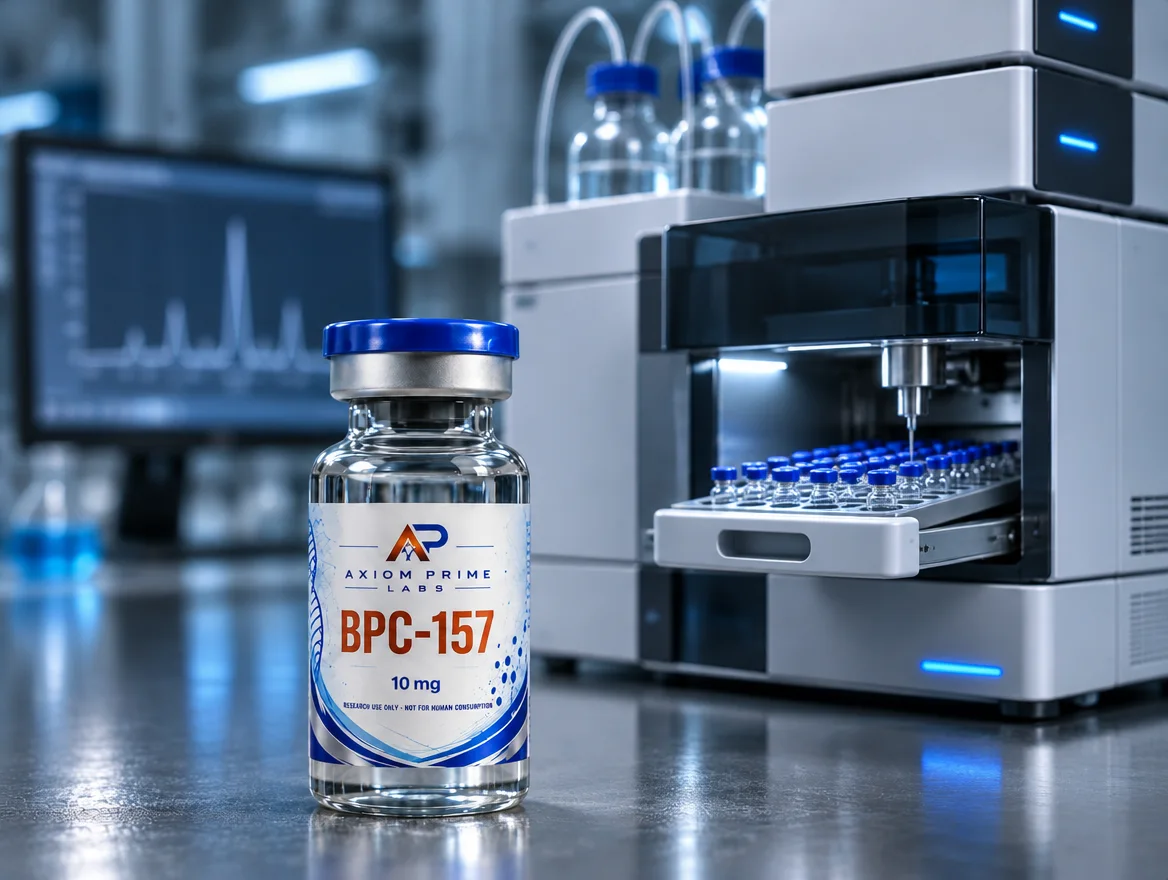
What Does ≥99% HPLC Purity Mean? Understanding Peptide Purity Testing
Almost every research peptide listing advertises a purity figure such as “≥98%” or “≥99% by HPLC.” But what does that number actually measure, and what doesn’t it tell you? Understanding purity testing helps you compare suppliers and choose material you can rely on.
What is HPLC?
High-performance liquid chromatography (HPLC) is an analytical technique that separates the components of a sample. The sample is dissolved and pushed under high pressure through a column packed with a stationary material. Different molecules interact with the column differently, so they travel through it at different speeds and emerge (or “elute”) at different times.
For peptides, the most common method is reversed-phase HPLC, often with UV detection at a wavelength where the peptide bond absorbs light (commonly around 214–220 nm).
Reading a chromatogram
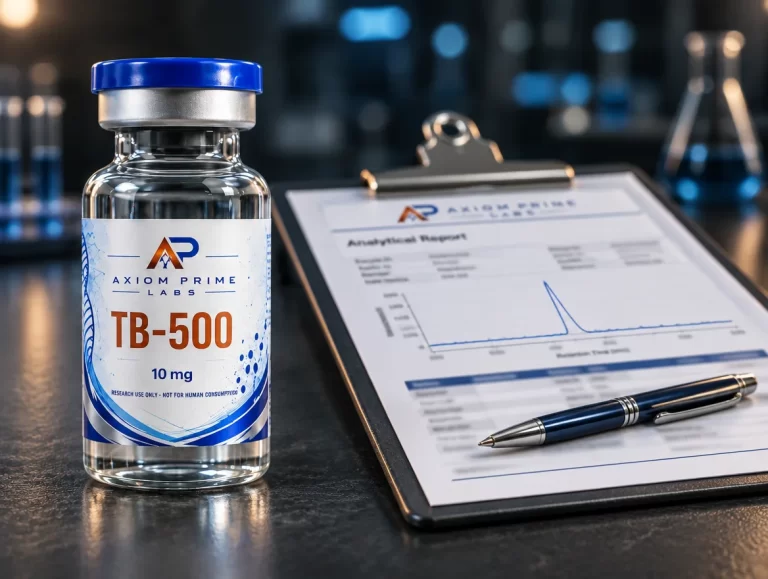
The output of an HPLC run is a chromatogram: a graph with time on the horizontal axis and detector signal on the vertical axis. Each component of the sample appears as a peak.
- The main peak represents the target peptide.
- Smaller peaks represent impurities, such as truncated or deletion sequences from synthesis, or degradation products.
Purity is calculated by comparing the area of the main peak with the total area of all peaks. If the main peak accounts for 99% of the total peak area, the sample is reported as 99% pure by HPLC.
What purity doesn’t tell you
HPLC purity is essential, but it has limits:
- It doesn’t confirm identity. A sample can be very pure and still be the wrong compound. Identity is confirmed separately, usually by mass spectrometry (MS), which measures molecular weight.
- It isn’t the same as peptide content. Lyophilized peptides also contain water and counter-ions (such as acetate or trifluoroacetate). Peptide content describes how much of the powder’s weight is actually peptide, which is different from chromatographic purity.
- It reflects one batch. Purity applies to the specific lot tested, which is why the lot number on a COA matters.
98% vs 99%: does it matter?
For many applications, the difference between 98% and 99% purity is small. More important is consistency: knowing that every batch is tested, that identity is confirmed, and that the report matches the lot you received. A verified 98% batch with full documentation is more useful than an unverified claim of 99%.
Questions to ask any supplier
- Is purity measured by HPLC for every batch?
- Is identity confirmed by mass spectrometry?
- Can I see the chromatogram, not just the number?
- Does the COA lot number match my vial?
Our guide to reading a Certificate of Analysis walks through each of these sections in detail.
Purity at Axiom Prime Labs
Every batch of our research materials is supported by analytical testing to verify identity and purity, with a Certificate of Analysis available for every product. See our Quality Standards, or browse our full research catalog.
All products are for laboratory research use only and are not for human or veterinary use.
Research-grade materials, batch-tested
Every Axiom Prime Labs product is supported by analytical testing with a Certificate of Analysis available for every batch. U.S. shipping, with free shipping on orders of $200+.