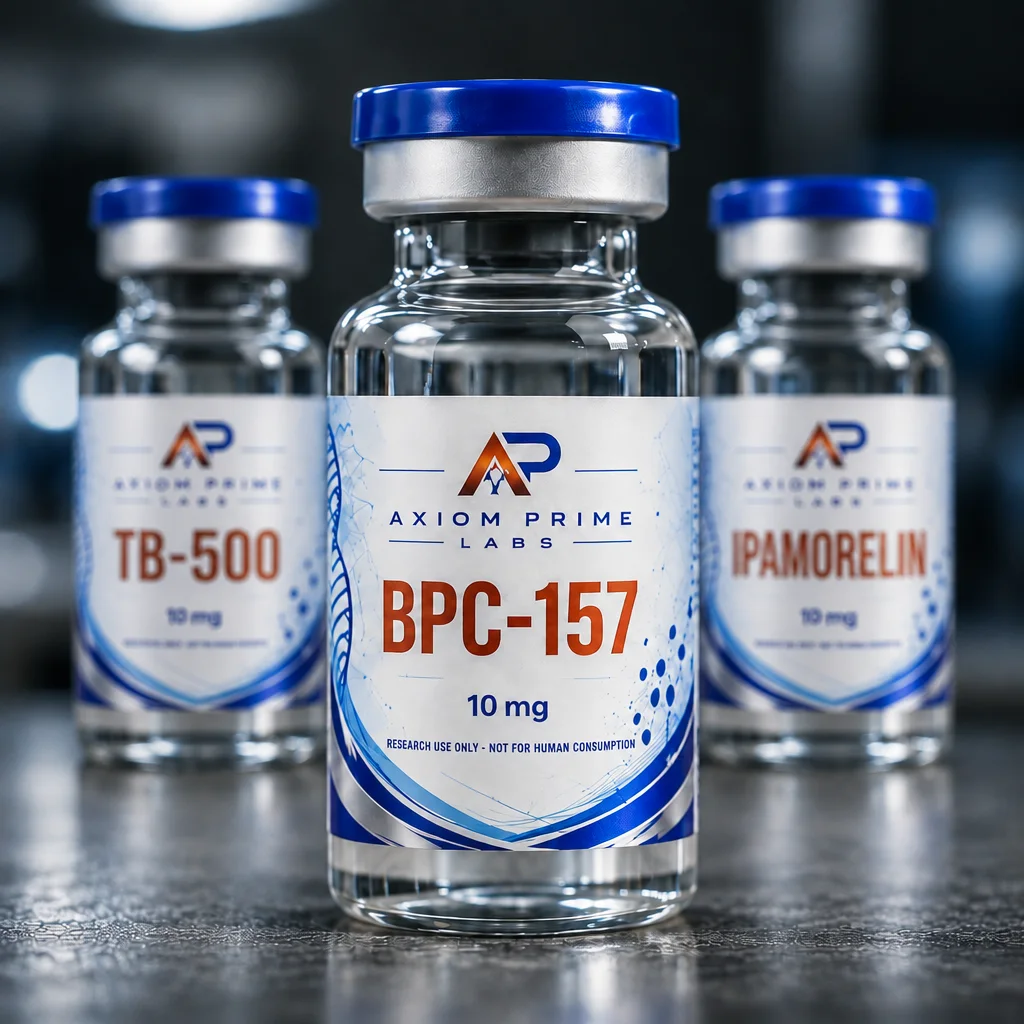
BPC-157 vs TB-500: How Two Widely Studied Research Peptides Compare
BPC-157 and TB-500 are two of the most frequently discussed peptides in preclinical research, and they’re often mentioned together. Despite that, they are very different molecules with different origins, structures and areas of scientific interest. This overview compares the two from a laboratory research perspective.
BPC-157 at a glance
BPC-157 (“Body Protection Compound 157”) is a synthetic pentadecapeptide, a chain of 15 amino acids, with the sequence GEPPPGKPADDAGLV and a molecular weight of roughly 1,419 Da. It is derived from a partial sequence of a protein found in human gastric juice.
BPC-157 has been studied extensively in preclinical (animal and in vitro) models, particularly in research related to gastrointestinal tissue, tendon and ligament models, angiogenesis and the nitric oxide (NO) system. Researchers often note its unusual stability, including in gastric juice. A 2025 literature and patent review in Pharmaceuticals summarizes much of this preclinical work (Pharmaceuticals, 2025 review).
TB-500 at a glance
TB-500 is a synthetic peptide related to thymosin beta-4 (Tβ4), a 43-amino-acid protein found in nearly all mammalian cells. Analytical studies of commercial TB-500 have identified it as the N-terminally acetylated fragment corresponding to residues 17–23 of Tβ4 (Ac-LKKTETQ), a seven-amino-acid sequence with a molecular weight of roughly 889 Da (Esposito et al., 2012).
This 17–23 region corresponds to the actin-binding domain of thymosin beta-4. Actin is a structural protein central to cell shape and movement, which is why TB-500 is studied in research involving cell migration, cytoskeletal dynamics and tissue repair models.
Side-by-side comparison
| Property | BPC-157 | TB-500 |
|---|---|---|
| Length | 15 amino acids | 7 amino acids (Ac-LKKTETQ) |
| Molecular weight | ~1,419 Da | ~889 Da |
| Origin | Partial sequence of a gastric juice protein | Fragment of thymosin beta-4 (residues 17–23) |
| Primary research focus | GI tissue models, angiogenesis, NO system, connective tissue models | Actin binding, cell migration, tissue repair models |
| Evidence base | Largely preclinical | Largely preclinical |
Why researchers study them together
Because BPC-157 and TB-500 appear to act through different mechanisms (one associated with angiogenesis and the NO system, the other with actin dynamics), they are sometimes investigated together in laboratory models of tissue repair. Our Wolverine Stack combines both research peptides in a single preparation, and our research stacks include other multi-compound combinations.
An important note on the evidence
Most published work on both peptides is preclinical. Neither BPC-157 nor TB-500 is approved by the FDA, and findings from animal and cell models do not establish effects in humans. Both should be treated strictly as research materials.
Sourcing research-grade material
Because both peptides are widely sold, quality varies significantly between suppliers. Always review the batch Certificate of Analysis for purity and identity confirmation. Axiom Prime Labs supplies BPC-157 and TB-500 as lyophilized research materials, batch-tested with a COA available for every product.
All products are for laboratory research use only and are not for human or veterinary use.
Research-grade materials, batch-tested
Every Axiom Prime Labs product is supported by analytical testing with a Certificate of Analysis available for every batch. U.S. shipping, with free shipping on orders of $200+.